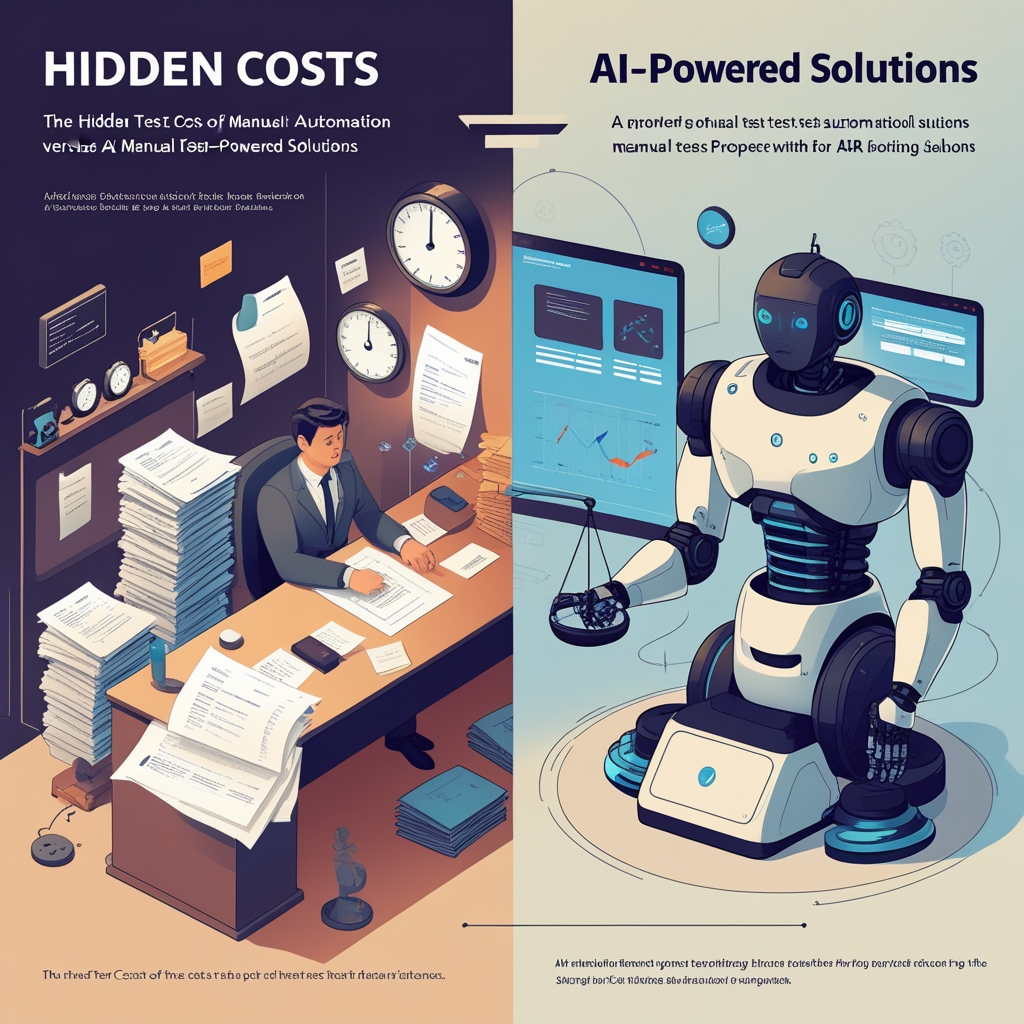
"We spent $150,000 on test automation last year, but our testing costs actually increased by 40%. The automation was working, but we were spending more time maintaining it than we saved. This is the hidden cost of manual test automation that nobody talks about."
1. The Automation Paradox: Why More Automation Doesn't Always Mean Lower Costs
Here's a scenario that plays out in organizations worldwide: A company invests heavily in test automation tools, hires automation engineers, and celebrates when they achieve 80% test automation coverage. But then something unexpected happens—their testing costs actually increase.
This is the automation paradox: the more you automate with traditional tools, the more resources you need to maintain that automation. It's like buying a high-maintenance sports car that requires constant tuning—the initial purchase is just the beginning of your expenses.
The Reality Check
Traditional test automation creates a maintenance burden that grows exponentially with your application's complexity. Every UI change, API modification, or feature addition requires manual updates to test scripts.
2. The Hidden Costs You're Probably Overlooking
Let's break down the real costs of manual test automation that most teams don't account for:
Cost #1: Maintenance Overhead
Every time your application changes, your test scripts need updates. This isn't just about fixing broken tests—it's about the cumulative time spent on maintenance that could be used for innovation. Industry averages show 40% of automation time is spent on maintenance, costing approximately $85K annually for a team of 5 automation engineers, with 15 hours per week spent on script maintenance.
Cost #2: False Positive Debugging
False positives—tests that fail due to script issues rather than actual application problems—are a major hidden cost. Every false positive requires investigation time, and in complex systems, this can consume significant resources.
Real Example: A fintech company with 500 automated tests was spending 20 hours per week investigating false positives. At $100/hour for senior QA engineers, that's $104,000 annually just on false positive debugging.
Cost #3: Team Productivity Loss
Manual test automation requires specialized skills. When your best QA engineers spend their time writing and maintaining scripts instead of strategic testing, you're losing their expertise where it matters most.
- Senior QA engineers writing scripts instead of designing test strategies
- Reduced focus on exploratory testing and user experience validation
- Delayed feedback on critical business features
- Increased time-to-market due to maintenance bottlenecks
Cost #4: Opportunity Cost of Delayed Releases
When test maintenance becomes a bottleneck, it delays feature releases. In today's competitive market, delayed releases can mean lost revenue, market share, and customer satisfaction.
Opportunity Cost Example
A SaaS company delayed a major feature release by 2 weeks due to test maintenance issues. The feature was expected to generate $50,000 in monthly recurring revenue. Opportunity cost: $25,000 in lost revenue. This doesn't include the cost of customer churn due to delayed features or the competitive advantage lost to faster-moving competitors.
3. The AI Solution: How TestNeo.ai Eliminates These Costs
AI-powered test automation fundamentally changes the cost equation by eliminating the maintenance burden and reducing the need for specialized automation skills.
Self-Healing Automation
TestNeo.ai's AI automatically adapts to application changes, eliminating the need for manual script maintenance. When UI elements change or APIs are updated, the AI system automatically updates test selectors and validation logic.
- 75% Less Maintenance: AI automatically handles script updates, reducing maintenance time from 15 hours to 4 hours per week.
- 80% Fewer False Positives: Intelligent test execution reduces false positives by understanding context and application behavior.
- Democratized Testing: Anyone can create tests using natural language, freeing senior QA engineers for strategic work.
- Faster Releases: Eliminate testing bottlenecks and reduce time-to-market by 60%.
Real ROI Calculation
Let's compare the costs of traditional automation vs. AI-powered testing for a 5-person QA team:
Annual Cost Comparison
Traditional Automation total: $240,000 (Engineers $85K + Maintenance $78K + False Positive Debugging $52K + Tool Licenses $25K). AI-Powered Testing (TestNeo.ai) total: $64,900 (Platform $35K + Minimal Maintenance $19.5K + Reduced False Positives $10.4K). Annual Savings: $175,100 (73% cost reduction).
4. Implementation Strategy: Transitioning to AI-Powered Testing
Transitioning from traditional automation to AI-powered testing doesn't have to be overwhelming. Here's a practical approach:
Phase 1: Assessment and Planning (Week 1-2)
- Audit current automation costs and maintenance burden
- Identify high-maintenance test scenarios for AI migration
- Set up TestNeo.ai trial and team training
- Define success metrics and ROI targets
Phase 2: Pilot Implementation (Week 3-6)
- Start with critical user journeys and API endpoints
- Create AI-powered tests using natural language
- Compare results with existing automation
- Measure time savings and maintenance reduction
Phase 3: Full Migration (Week 7-12)
- Gradually migrate existing test scenarios
- Train team on AI-powered testing best practices
- Integrate with CI/CD pipelines
- Monitor and optimize performance
5. Success Stories: Real Results from AI-Powered Testing
Case Study: E-commerce Platform Transformation
Challenge: A mid-size e-commerce company was spending $180,000 annually on test automation maintenance, with 60% of their QA team's time dedicated to script updates.
Solution: Implemented TestNeo.ai for their critical user journeys and API testing.
Results:
- 85% reduction in maintenance time
- 90% fewer false positives
- $153,000 annual cost savings
- QA team now focuses on strategic testing and user experience
Case Study: Fintech Startup Acceleration
Challenge: A fintech startup needed to scale their testing as they grew from 10 to 100+ features, but couldn't afford a large QA team.
Solution: Adopted TestNeo.ai from the beginning, using natural language to create comprehensive test coverage.
Results:
- 3x faster test creation
- Zero maintenance overhead
- 50% faster release cycles
- Competitive advantage through faster feature delivery
6. Making the Business Case: ROI for Decision Makers
When presenting AI-powered testing to stakeholders, focus on these key business metrics: 73% cost reduction, 60% faster releases, 75% less maintenance, and 3x faster test creation.
7. Conclusion: The Future of Cost-Effective Testing
The hidden costs of manual test automation are real, and they're growing as applications become more complex. Traditional automation tools create a maintenance burden that often outweighs their benefits.
AI-powered testing with TestNeo.ai eliminates these hidden costs by:
- Automating maintenance through self-healing capabilities
- Reducing false positives with intelligent test execution
- Democratizing testing so anyone can create effective tests
- Accelerating releases by eliminating testing bottlenecks
The choice is clear: continue paying the hidden costs of manual automation, or embrace AI-powered testing that delivers true ROI and competitive advantage.